
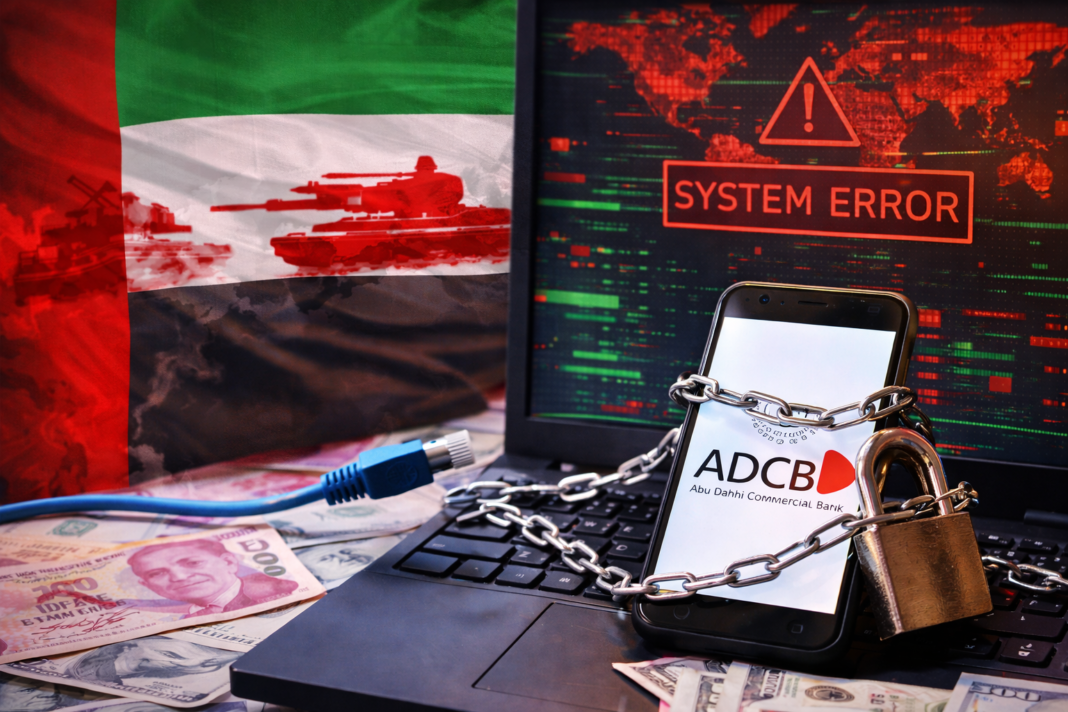

A significant suspension of digital operations was documented on Monday, February 23, 2026, as Abu Dhabi Commercial Bank (ADCB) reported that its mobile banking applications and contact center services had been rendered temporarily unavailable. It was articulated by the institution, which serves as the United Arab Emirates’ third-largest lender by assets, that these service outages were the direct result of a widespread IT disruption currently affecting the broader Gulf region. While specific technical details regarding the nature of the fault were not disclosed by the bank, institutional observers have noted a potential correlation between these outages and reported disruptions at Amazon Web Services (AWS) data centers located within Bahrain and the United Arab Emirates. These infrastructural failures have manifested following a series of Iranian missile and drone strikes directed at various targets within the region, including military installations utilized by the United States.
The geopolitical environment has been characterized by extreme volatility following what has been described as a retaliatory strike by Iran in response to a joint United States-Israeli assault. These hostilities have reached across every major Gulf state, challenging the established reputation of the region as a global benchmark for business reliability and security. The human and economic costs of the conflict were underscored by the reporting of three fatalities within the United Arab Emirates, while audible explosions were documented in the primary urban centers of Dubai and Abu Dhabi for a third consecutive day. This escalation has triggered the most extensive level of business disruption observed in the Middle East since the global pandemic, necessitating the closure of international airports and the cessation of maritime operations at several key ports.
In the financial sector, the impact of the strikes led to an immediate and unprecedented administrative intervention by the UAE Capital Markets Authority. Activity on both the Abu Dhabi Securities Exchange and the Dubai Financial Market was suspended until Wednesday at the earliest, a move designed to prevent disorderly trading and preserve market integrity amidst the escalating violence. Consequently, shares of ADCB were not traded on Monday. The bank remains an entity of significant state importance, as a majority stake of 60.69% is held by the Abu Dhabi government through its sovereign wealth fund, the Mubadala Investment Company. The stability of such institutions is viewed as vital to the national interest, particularly when regional shockwaves threaten to derail the financial architecture of the Gulf.
The technical vulnerabilities exposed by this conflict have prompted a re-evaluation of the reliance on centralized cloud service providers within the Middle East. It is understood that the regional digital ecosystem is heavily dependent on localized data hubs; therefore, any kinetic strike affecting physical infrastructure can have an immediate and cascading effect on consumer-facing digital services, such as mobile banking. The disruption to ADCB’s contact centers further exacerbated the situation, as customers found themselves unable to access traditional support channels during a period of heightened public anxiety. Analysts have suggested that the restoration of these services will depend not only on the physical repair of data centers but also on the mitigation of ongoing cyber-related threats that often accompany kinetic warfare.
Beyond the immediate banking sector, the broader commercial landscape of the Gulf states is currently navigating a period of profound uncertainty. The reputation of the region as a “safe haven” for international investment and a hub for global logistics is being tested by the reality of long-range missile capabilities and drone incursions. The suspension of stock market activity is viewed as a defensive maneuver to allow for a period of cooling and assessment, yet the long-term implications for investor confidence remain a subject of intense debate among global economists. It is maintained by several strategic experts that the resilience of the region’s digital and physical infrastructure will be the primary determinant of how quickly business normalcy can be restored once the immediate military tensions subside.
Ultimately, the events of Monday have highlighted the fragility of modern digital economies when confronted with high-intensity regional conflict. The inability of a premier financial institution like Abu Dhabi Commercial Bank to maintain its digital interfaces serves as a stark reminder of the physical dependencies of the “cloud.” As the situation develops, the focus of the international community will likely remain on the security of the Gulf’s energy and financial corridors, which are essential to the stability of the global economy. The recovery of the ADCB service platforms will likely be monitored as a proxy for the broader restoration of the UAE’s technological and commercial equilibrium.