
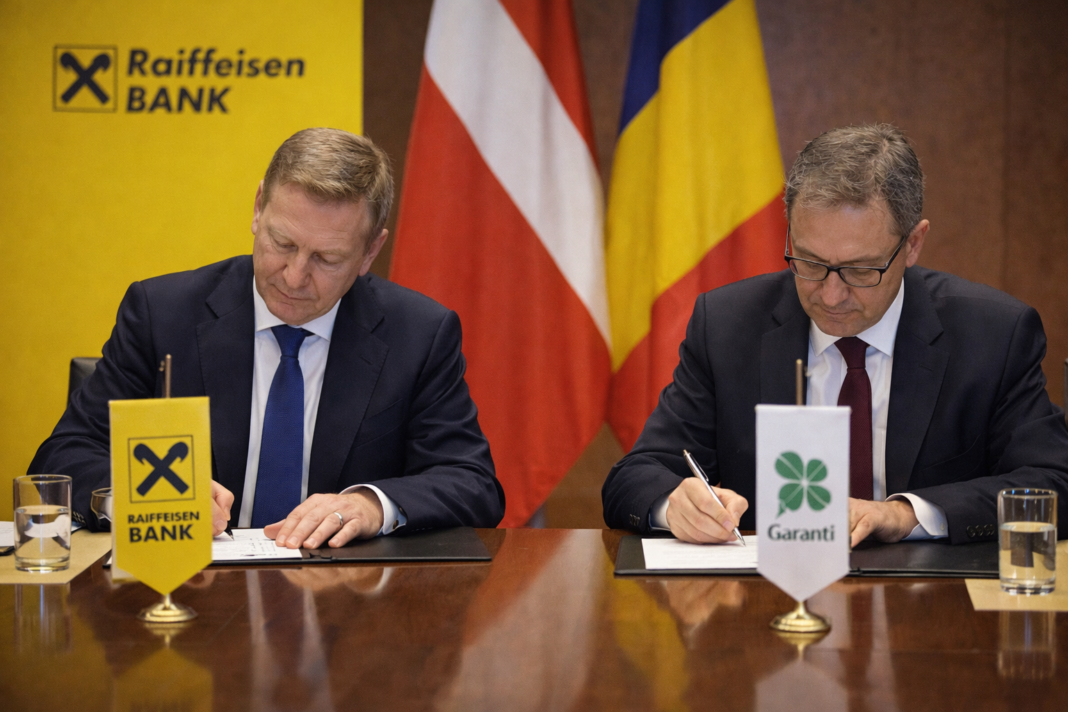

A significant realignment within the banking landscape of Southeast Europe was documented on Tuesday, March 10, 2026, as it was reported by sources familiar with the negotiations that Austria’s Raiffeisen Bank is approaching a definitive agreement to acquire the Romanian operations of BBVA’s Garanti unit. It has been indicated that the Vienna-based lender has submitted a proposal to purchase the business at a valuation of approximately 1.2 times its book value, a metric that implies a total transaction price in the vicinity of 550 million euros. While formal comments have been declined by both BBVA and Raiffeisen, the potential deal is perceived by market analysts as a landmark event, representing the first major acquisition undertaken by the Austrian institution in several years.
The historical context of this transaction is rooted in a prolonged period of strategic consolidation for Raiffeisen, during which the bank’s primary focus was directed toward navigating the complexities of its operations in Russia. Following the geopolitical shifts and the imposition of Western sanctions resulting from the conflict in Ukraine, the bank has faced sustained pressure to reduce its exposure to the Russian market. Consequently, the pursuit of the Garanti unit in Romania is viewed as a definitive turning point, signaling a pivot back toward growth within stable European Union jurisdictions. It was previously articulated by Raiffeisen Bank CEO Johann Strobl that the institution maintained a sufficient capital buffer for strategic acquisitions, specifically identifying the Romanian market as a territory of high interest.
The current environment within the Romanian financial sector is characterized by a scarcity of high-quality takeover targets, a factor that has contributed to a “seller’s market” dynamics. It has been maintained by individuals close to the situation that a purchase price exceeding the book value is considered unavoidable under such competitive conditions. This scarcity is exacerbated by a broader trend of regional consolidation, as major European players seek to build scale in high-growth markets where loan demand remains robust. This trend was reflected in Raiffeisen’s preliminary 2025 financial results, which documented a 48% increase in consolidated profit, driven largely by accelerating loan growth across its existing European portfolio.
From a regulatory perspective, the potential transaction coincides with a significant overhaul of merger rules being weighed by the European Commission. These proposed changes are intended to facilitate the ability of regional corporations to achieve greater scale through cross-border acquisitions, marking the first substantial revision of such frameworks in more than two decades. Should the acquisition of the Garanti unit be finalized, Raiffeisen’s position as the fourth-largest lender in Romania would be substantially fortified, potentially challenging the dominance of the top three institutions in that market. While Garanti BBVA has noted in stock-exchange disclosures that a final decision has not yet been reached and that all strategic options remain under evaluation, the momentum of the negotiations suggests a high probability of a formal accord.
The broader geopolitical implications of the deal are also being scrutinized, particularly as the ongoing Middle East conflict continues to influence global risk appetite and energy prices. In an era of heightened volatility, the consolidation of banking assets within the Eurozone’s eastern frontier is seen as a move toward greater institutional resilience. By diversifying its revenue streams away from high-risk territories and into the regulated Romanian market, Raiffeisen is perceived to be strengthening its long-term stability. The success of this acquisition will likely serve as a barometer for the appetite of other Central European banks to re-engage in large-scale domestic mergers and acquisitions.
Ultimately, the 2026 narrative for Raiffeisen Bank is one of structural renewal and geographic refocusing. The transition from a defensive posture necessitated by the Russian crisis to an offensive strategy centered on European growth represents a significant recovery of its corporate mandate. As the due diligence process for the Garanti unit nears its conclusion, the focus of the international investment community will remain fixed on the final valuation and the degree to which the European Commission’s new merger rules will assist in the integration of the two entities. The acquisition is not merely a transaction for a local subsidiary, but a foundational step in the broader effort to harmonize the European banking sector in an increasingly fragmented global economy.