
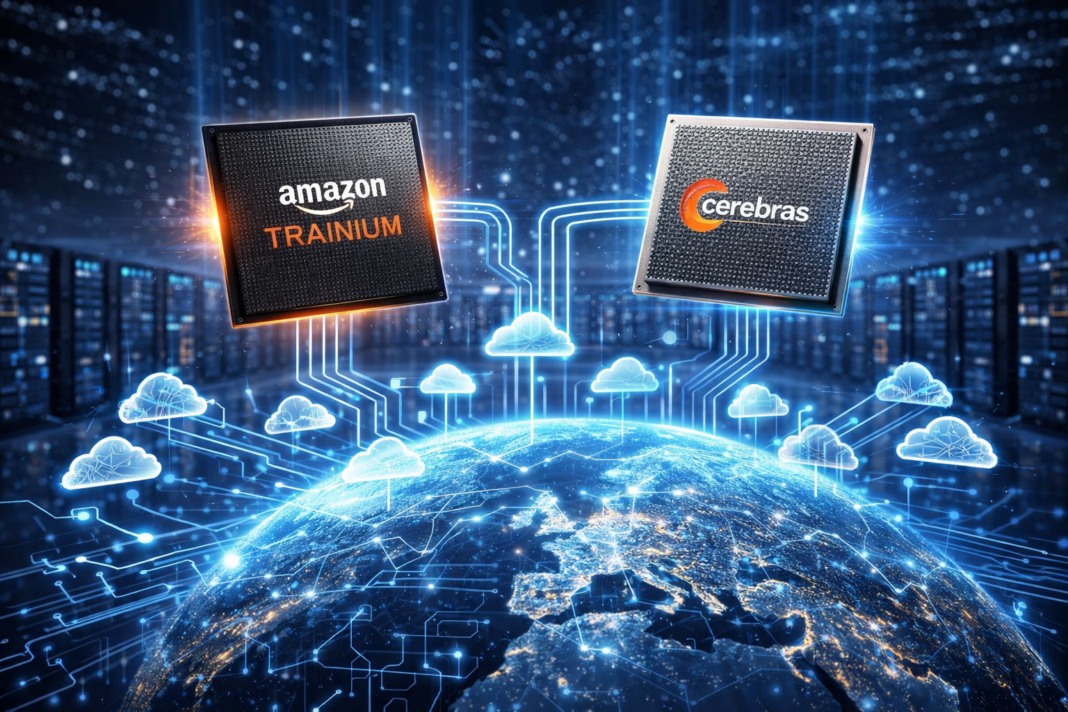

A significant restructuring of the artificial intelligence hardware landscape was documented on Friday, March 13, 2026, as it was confirmed that Amazon.com and the semiconductor startup Cerebras Systems have entered into a definitive agreement to integrate their respective computing architectures. This collaboration is designed to facilitate a new high-performance service intended to accelerate the operation of sophisticated chatbots, automated coding instruments, and various other artificial intelligence applications. Cerebras, which is currently valued at $23.1 billion, has positioned itself as a primary challenger to the market dominance of Nvidia by developing a fundamentally distinct processor architecture. Unlike traditional high-performance chips, the Cerebras design is noted for its lack of reliance on expensive high-bandwidth memory, a technical departure that follows a landmark $10 billion supply agreement reached with OpenAI earlier this year.
Under the terms of the newly disclosed arrangement, Cerebras hardware will be deployed within Amazon Web Services (AWS) data centers and strategically interfaced with Amazon’s proprietary Trainium3 custom AI silicon. This integration is to be supported by a specialized networking fabric developed by Amazon, creating a unified environment for the execution of large-scale models. It has been maintained by Cerebras CEO Andrew Feldman that this partnership will effectively lower the barriers to entry for high-speed computing, allowing a diverse range of clients—spanning from independent developers to global financial institutions—to access Cerebras’s capabilities through the existing AWS interface. While the specific financial parameters of the deal were not disclosed by either party, the operational implications for the cloud computing market are considered profound.
The technical focus of the collaboration is directed toward the optimization of “inference,” the computational phase where trained artificial intelligence systems process user queries to generate specific outputs. A “divide and conquer” strategy has been articulated by both firms, whereby the inference task is bifurcated into two distinct mechanical stages. The first stage, referred to as “prefill,” involves the translation of human language into the “tokens” utilized by neural networks. This initial processing is to be managed by Amazon’s Trainium3 chips. The subsequent “decode” stage, in which the actual response is formulated and delivered to the user, will be handled by the Cerebras hardware. This specialized allocation of tasks is intended to maximize the efficiency of each chip’s specific strengths, thereby reducing latency for end-users.
This architectural approach is observed to mirror the strategic shifts currently being pursued by major competitors in the semiconductor industry. It is noted by market analysts that a similar methodology is expected to be unveiled by Nvidia, following its $17 billion acquisition of the startup Groq in late 2025. By combining general-purpose graphics processing units with specialized inference accelerators, the industry is moving toward a hybrid model of computational delivery. However, it was asserted by Amazon that its Trainium-led offering, which is scheduled to become operational in the second half of 2026, is positioned to provide superior price-performance value compared to the solutions currently offered by merchant silicon providers.
The broader economic context of this agreement is defined by the ongoing geopolitical volatility in the Middle East and its associated impact on the global supply chain for critical electronics. As energy prices fluctuate and shipping corridors face disruption, the necessity for high-efficiency, cost-effective AI infrastructure has become a paramount concern for cloud service providers. The development of the Trainium3 and the roadmap for the forthcoming Trainium4 architecture are viewed as efforts by Amazon to insulate its ecosystem from the rising costs of third-party hardware. By leveraging Cerebras’s unique wafer-scale technology, which integrates memory and processing on a single piece of silicon, the dependency on the bottlenecked high-bandwidth memory market is significantly mitigated.
Furthermore, the integration of these chips into the AWS framework is perceived as a move toward the commoditization of high-performance AI. As the demand for agentic artificial intelligence continues to expand, the ability to provide instantaneous, cost-effective inference will likely determine the market leaders of the next decade. The collaboration between a dominant cloud provider and a disruptive chip architect is seen as a mechanical necessity to maintain the scaling laws of modern intelligence. While the timeline for competing pairings remains characterized by uncertainty, the Amazon-Cerebras program is described as being only months away from supporting production workloads.
Ultimately, the 2026 narrative for the semiconductor industry is one of architectural divergence. The move away from a monolithic GPU-centric model toward a specialized, multi-chip inference pipeline represents a maturation of the AI factory. As the second half of the year approaches, the focus of the global investment community will remain fixed on the real-world performance metrics of the Trainium3-Cerebras pairing and the degree to which it can successfully disrupt the established hierarchy of AI compute. The success of this partnership will serve as a primary indicator of whether vertically integrated cloud providers can effectively challenge the supremacy of specialized chip manufacturers in the era of pervasive artificial intelligence.