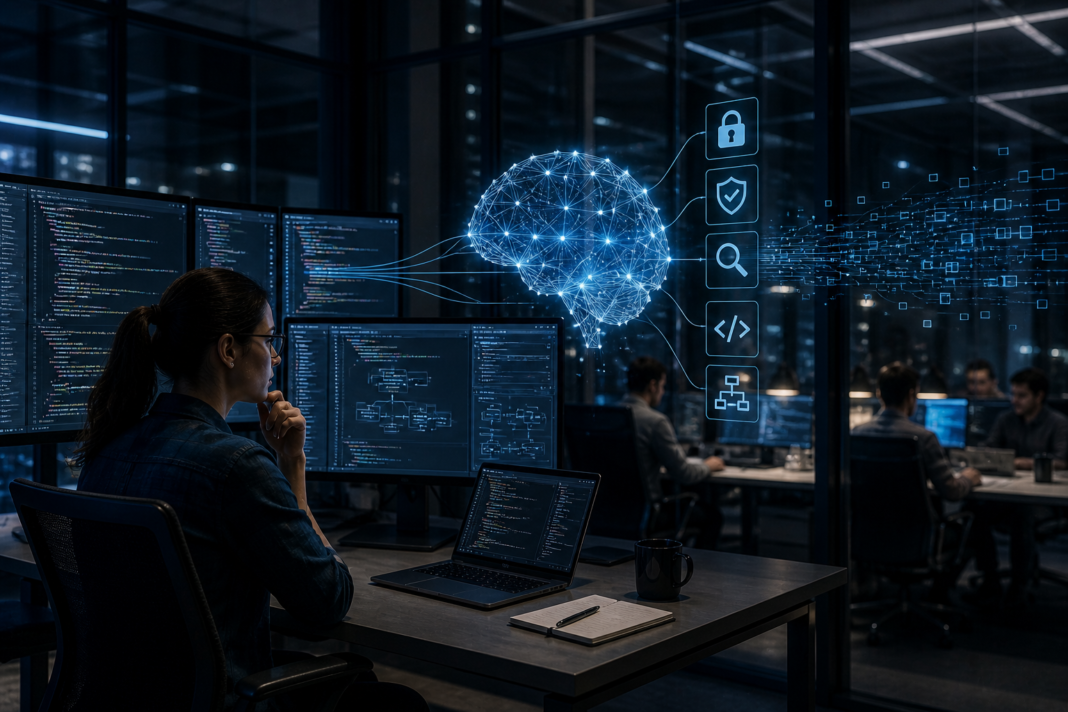

A significant advancement in the methodology of cybersecurity was announced by Microsoft on Wednesday, as plans were disclosed to embed sophisticated artificial intelligence models into its foundational secure coding architecture. It was revealed that the initiative involves the integration of Anthropic’s recently unveiled Claude Mythos Preview into the Security Development Lifecycle (SDL), a move intended to bolster the company’s defensive capabilities. The primary objective of this integration, as detailed in an official communication from the Windows manufacturer, is the identification of software vulnerabilities and the accelerated development of remedial fixes during the early stages of the production cycle. This shift toward AI-enhanced security is interpreted as a mechanical necessity in an era where the speed of digital threats continues to outpace traditional human-led oversight.
The Claude Mythos model, which was formally introduced to the technology sector on April 7, is reported to have already demonstrated a formidable capacity for detection, having successfully identified thousands of major vulnerabilities within various operating systems, web browsers, and diverse software applications. It is maintained by industry experts that the model’s advanced coding proficiency provides it with an unprecedented ability to analyze complex digital structures and devise methods for their exploitation. Consequently, the deployment of such a tool within a defensive framework is viewed as a critical step in neutralizing the risks posed by adversarial entities who might utilize similar technologies for malicious purposes.
Under a controlled initiative known as Project Glasswing, the current iteration of the model is being deployed to a select cohort of major technology enterprises. This program, orchestrated by Anthropic, facilitates the use of the model by organizations such as Microsoft, Amazon, and Apple for the explicit purpose of identifying cybersecurity weaknesses within a secure and monitored environment. It was stated by Microsoft that the Mythos model had been subjected to rigorous evaluation utilizing its own proprietary open-source benchmarks, which are specifically designed for real-world detection engineering tasks. The results of these assessments are reported to have indicated substantial improvements in performance relative to any prior generative models, further justifying its inclusion in the core security infrastructure.
The emergence of the Mythos model has also attracted the attention of national governance and international financial leadership. It is observed that the administration of President Donald Trump, alongside central bankers and various industrial leaders, is currently engaged in an urgent effort to comprehend the implications of this technology. The ability of the model to simplify and accelerate the execution of complex cyberattacks is regarded as a primary concern for those responsible for the stability of national infrastructure and global financial systems. The dual-use nature of the technology—acting as both a powerful tool for defense and a potential instrument for offense—has necessitated a rapid recalibration of security priorities across both the public and private sectors.
From a technical perspective, the incorporation of high-level coding models into the Security Development Lifecycle represents a transition toward a more proactive and automated form of digital hygiene. By utilizing these tools to scan source code for subtle flaws before deployment, the frequency of zero-day exploits and subsequent security breaches is expected to be significantly reduced. This approach aligns with the broader “Muskonomy” of 2026, where the integration of advanced intelligence into every facet of industrial and digital life is pursued as a prerequisite for survival in a highly competitive and increasingly hostile technological landscape. The efficiency gains provided by the model in the “red teaming” process—the simulated attacking of one’s own systems—are viewed as an essential component of modern software engineering.
Furthermore, the collaboration between Anthropic and the world’s leading technology firms under Project Glasswing signifies a new era of industrial cooperation in the field of cybersecurity. While these organizations remain fierce competitors in the marketplace, the shared threat of sophisticated cyber warfare has fostered a temporary alignment of interests. The collective utilization of the Mythos model allows for a more comprehensive understanding of emerging vulnerabilities across a wide range of platforms, thereby enhancing the overall resilience of the global digital ecosystem. It is maintained that the findings generated through this initiative will be utilized to strengthen the security protocols of products used by billions of individuals and businesses worldwide.
Ultimately, the decision by Microsoft to adopt Claude Mythos as a pillar of its security framework serves as a definitive signal that the future of software protection is inextricably linked to the advancement of artificial intelligence. As the 2026 fiscal year progresses, the success of this integration will likely be measured by the reduction in successful cyberattacks against the company’s platforms and the speed with which new threats are identified and neutralized. While the potential for the model to facilitate more rapid attacks remains a source of institutional anxiety, its deployment as a defensive asset is viewed as a hard-won victory for the proponents of AI-driven security. The transition toward an environment where code is perpetually monitored and refined by intelligent agents marks the beginning of a new chapter in the ongoing effort to secure the foundations of the modern digital world.