
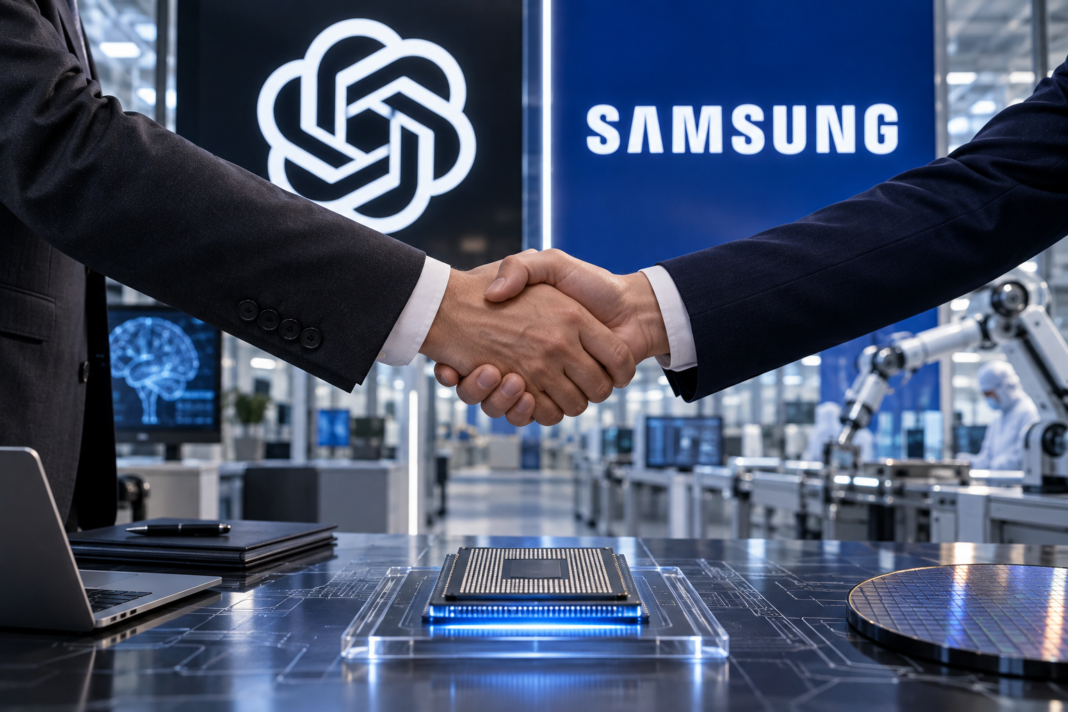

OpenAI is expanding its collaboration with Samsung Electronics as the ChatGPT developer works on its own artificial intelligence chips, strengthening ties with the South Korean technology giant across semiconductor research, chip production and enterprise AI services.
Harrison Kim, General Manager of OpenAI Korea, said Wednesday at a press conference in Seoul that the two companies had made significant progress in jointly researching and producing next-generation chips being developed by OpenAI. He described the cooperation with Samsung as one of the areas where OpenAI had received substantial recognition, although he did not provide further details about the chips.
The partnership comes as OpenAI seeks to build greater control over the hardware needed to support its rapidly expanding AI operations. The company unveiled its first custom AI chip in June, working with Broadcom on a processor called Jalapeno. OpenAI engineers designed the chip for AI inference, the process through which systems handle data and generate responses to user requests in applications such as ChatGPT.
OpenAI said at the time that Taiwan Semiconductor Manufacturing Co., or TSMC, would manufacture the chips. Its growing engagement with Samsung therefore adds another major Asian semiconductor company to its broader hardware strategy.
Samsung’s role also extends beyond chip development. Kim said Samsung Electronics represents one of the largest-scale deployments of ChatGPT, with employees in South Korea and other countries using the AI service for activities including research and development, marketing and sales.
Samsung Electronics, however, said it could not confirm information concerning its customers.
OpenAI has also established relationships with South Korea’s broader semiconductor industry. Last year, Samsung Electronics and SK Hynix signed letters of intent to provide memory chips for OpenAI’s Stargate data centre project.
Kim said OpenAI expects demand for memory semiconductors to keep increasing as increasingly sophisticated chips require greater computing capabilities. For OpenAI’s Korean operations, he said, maintaining cooperation with South Korean semiconductor suppliers is therefore an important priority.
Samsung is simultaneously increasing its own use of generative AI tools. In June, the company announced that employees in its Device eXperience division would be permitted to use ChatGPT, Google’s Gemini and Anthropic’s Claude internally. The division is responsible for products including mobile phones, televisions and home appliances.
OpenAI also reported strong growth in corporate adoption of ChatGPT in South Korea. The company said the number of ChatGPT Enterprise users at South Korean companies and institutions had increased approximately 28-fold by the end of August compared with a year earlier. Businesses are increasingly moving beyond using AI for individual assignments and are applying the technology across wider organisational operations.
Those applications now include areas such as legal work, sales, finance, marketing and operations, according to OpenAI. The company did not disclose the absolute number of users.
South Korea has emerged as an important market for OpenAI. The company said that as of late last year, the country had the largest number of paying ChatGPT subscribers outside the United States.
OpenAI expects corporate and consumer adoption to continue gaining momentum following the September 4 launch of GPT-6 Astra, its latest AI model. The company said the model delivers improved capabilities in areas including computer use, professional tasks, science, coding and cybersecurity.
The strengthening relationship with Samsung comes as OpenAI works to expand both its AI infrastructure and commercial presence. Cooperation with one of the world’s major semiconductor manufacturers could support its efforts to secure advanced computing and memory technology, while Samsung’s growing internal use of generative AI gives the partnership an additional enterprise dimension. For South Korea, the relationship also highlights the country’s importance to OpenAI’s ambitions in both AI hardware and business adoption. With Samsung Electronics and SK Hynix already linked to OpenAI’s planned infrastructure through memory-chip supply agreements, the latest cooperation points to deeper connections between the ChatGPT developer and the country’s semiconductor supply chain.