
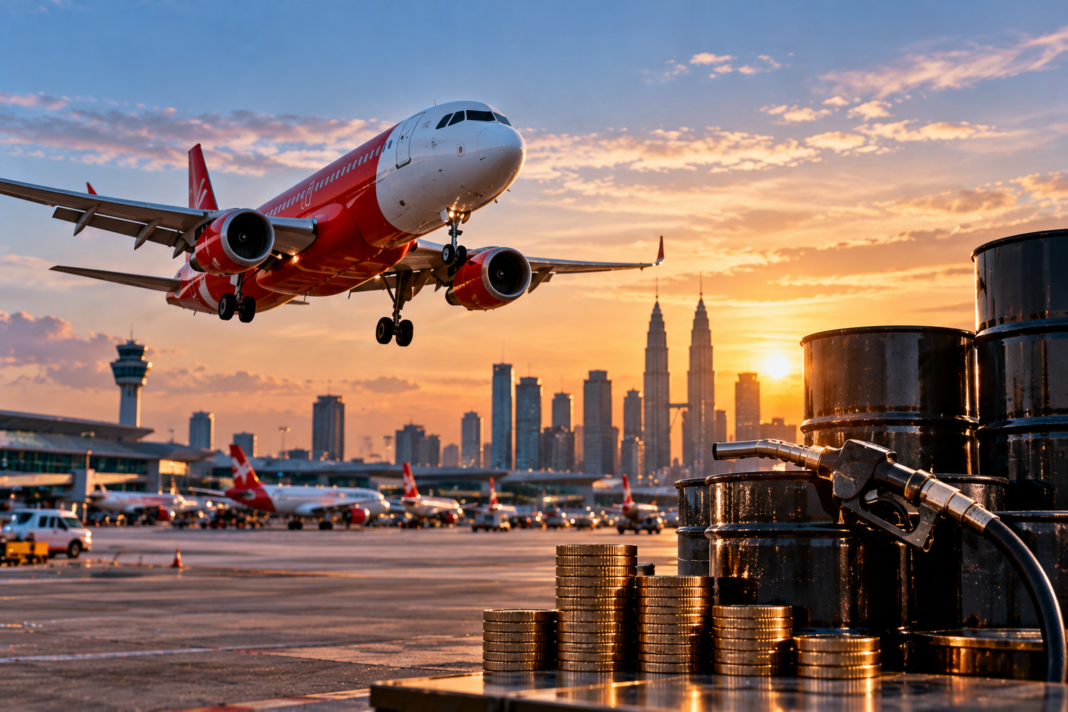

Malaysia’s government has confirmed that it has not agreed to provide financial assistance to budget airline operator AirAsia, despite growing concerns about the carrier’s financial position following a sharp increase in jet fuel prices. In a parliamentary response issued on Monday, October 19, 2026, the Finance Ministry said it was monitoring developments in the aviation industry but had made no commitment to offer the airline financial support.
The clarification comes as AirAsia faces mounting cost pressures linked to higher fuel expenses. The ministry acknowledged the challenges affecting the airline while emphasizing that any potential government assistance would have to be assessed carefully, taking into account national interests, public finances and the protection of taxpayers’ money.
AirAsia, one of Malaysia’s major low-cost carriers, has reportedly held discussions with the government about possible support. Reuters reported earlier this month, citing sources familiar with the matter, that the airline was exploring potential assistance with Malaysian authorities. However, the discussions were not necessarily focused on direct financial aid.
AirAsia co-founder Tony Fernandes previously explained that the conversations centred on aviation-related operating expenses, including airport charges and fuel costs, rather than a request for financial assistance. These expenses have become increasingly important as airlines face uncertainty over fuel prices and the broader economic consequences of geopolitical tensions.
The Finance Ministry’s latest statement makes clear that discussions between the government and the aviation industry should not be interpreted as a formal agreement to provide funding. It specifically stated that no arrangement had been reached to extend financing to AirAsia through government guarantees, loans or direct injections of public funds.
The ministry also confirmed that it was following the financial performance of aviation companies, including AirAsia’s recent quarterly losses, which were attributed to higher fuel costs associated with the US-Israeli war with Iran. The increase in operating expenses has added pressure to the airline’s financial position and intensified attention on the wider challenges confronting Malaysia’s aviation sector.
Although the government has not committed to supporting AirAsia financially, it said it was maintaining regular communication with businesses operating in the aviation industry. Officials are gathering feedback from companies, industry representatives and technical specialists to understand the effects of the Middle East crisis on economic activity.
The ministry explained that this approach was not limited to aviation. The government was also consulting businesses and experts in other sectors affected by the regional crisis to evaluate their difficulties and understand the potential economic consequences.
However, the government stressed that any future request for assistance would be examined under established legal and administrative procedures. According to the ministry, decisions would depend on whether support served the interests of Malaysia and its citizens, remained consistent with the government’s fiscal sustainability objectives and protected public funds.
This position indicates that any potential assistance would be considered on a case-by-case basis rather than automatically extended to companies experiencing financial difficulties. The ministry did not announce any specific financial package or indicate that AirAsia would receive government funding in the future.
Despite the absence of a funding commitment, the government recognized AirAsia’s importance to Malaysia’s aviation network. The airline accounts for a substantial proportion of passenger traffic handled by the country’s airports, making its operations significant to domestic travel and broader connectivity.
According to the Finance Ministry, AirAsia represented approximately 41% of the 104.5 million passenger movements recorded at airports operated by Malaysia Airports Holdings in 2025. The carrier also accounted for nearly 60% of domestic passenger movements, highlighting its prominent position in the country’s internal aviation market.
These figures demonstrate the airline’s considerable role in transporting passengers throughout Malaysia. Its importance extends beyond major urban centres, particularly in the country’s eastern states of Sabah and Sarawak, located on the island of Borneo.
The ministry noted that AirAsia contributes significantly to maintaining air connections to Sabah and Sarawak. Reliable aviation links are important for connecting these regions with other parts of Malaysia, making the airline an important participant in the country’s transport network.
Nevertheless, the carrier’s importance to national connectivity does not amount to a guarantee of financial assistance. The government has maintained a distinction between recognizing AirAsia’s contribution to the economy and committing public resources to support its operations.
For now, Malaysia’s authorities are continuing to assess the effects of higher fuel prices and geopolitical uncertainty on the aviation industry. AirAsia’s financial challenges remain an area of concern, but the government has made clear that no financing agreement has been reached.
The airline’s reported discussions with officials may continue to attract attention as the industry responds to rising costs. Any future assistance, however, would depend on a formal assessment of the request and its implications for public finances, national interests and the responsible use of government funds.