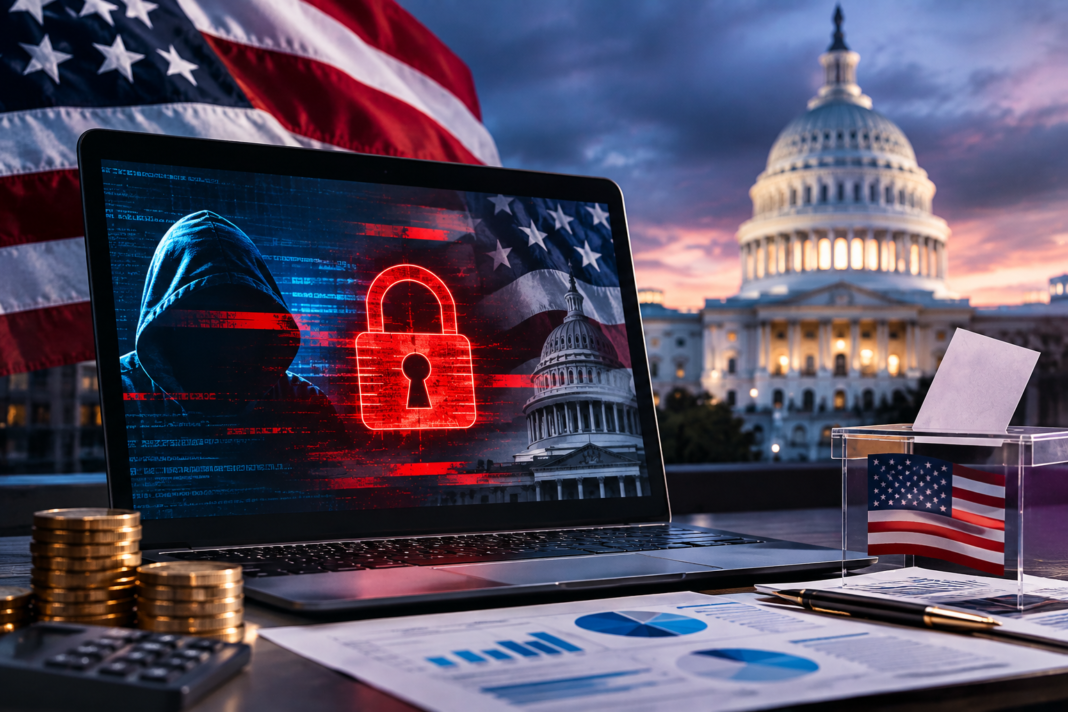

A cyberattack on the US Federal Election Commission (FEC) temporarily interrupted public access to political campaign finance disclosures, leaving spending by wealthy donors and outside political groups less visible during the final days before the November 3 midterm elections.
By Wednesday night, October 28, 2026, the FEC had restored its electronic filing system after keeping it offline for nearly 41 hours to contain the security incident. The disruption prevented political organizations from submitting mandatory reports detailing their latest spending, raising concerns among campaign finance watchdogs about transparency at a critical stage of the election cycle.
The affected filings include reports required within 24 and 48 hours by super political action committees, known as super PACs, and other political groups. These disclosures allow the public to track spending intended to support or oppose candidates shortly before voters head to the polls.
As the outage continued into its third evening, campaign finance monitoring organizations warned that the interruption had obscured significant amounts of political spending from public view.
Molly White, a campaign finance watchdog who monitors political spending by the cryptocurrency industry and major technology companies, said the disruption prevented observers from seeing how much money was being spent in the final stretch of the campaign.
She emphasized that political expenditures typically accelerate as Election Day approaches, making access to timely disclosure records particularly important. The inability to review those filings so close to the election, she said, was especially damaging.
The interruption coincided with a period of exceptionally heavy political spending. According to Brendan Glavin, research director at OpenSecrets, super PACs and dark money organizations spent an average of more than $50 million per day during the week preceding the outage. More than $250 million in spending was reported on October 20 alone.
Super PACs can raise and spend unlimited sums to influence elections, while dark money groups can operate through structures that make the original sources of some political funding difficult to identify. Their spending has made timely public disclosure an important issue for organizations monitoring the influence of money in American politics.
Hilary Braseth, executive director of the nonpartisan campaign finance watchdog OpenSecrets, criticized the interruption in a statement issued before the filing system returned to service.
She argued that delayed disclosure undermines transparency, particularly when hundreds of millions of dollars in outside political spending are entering the electoral process during the final days of a campaign. Public access to these records, she said, serves as an essential safeguard rather than an optional feature of the election system.
The FEC initially informed users of a technical problem shortly after 10 p.m. Eastern Time on Monday, October 26, saying the issue had caused major disruptions across systems used to process electronic campaign finance filings.
The agency later indicated that most affected services had been restored. However, it did not publicly provide detailed information about the incident or explain the precise cause of the disruption.
An FEC official informed campaign compliance firms in an email late Monday that the agency had taken the services offline after a “bad actor” attempted to breach its systems, according to correspondence reviewed by Reuters.
Campaign finance managers were also instructed to reset their passwords before accessing the filing platform again, according to another email reviewed by Reuters.
The circumstances surrounding the attack remained unclear. Reuters was unable to determine the motive behind the attempted breach, and the FEC did not respond to requests for comment on Wednesday. The Cybersecurity and Infrastructure Security Agency and the Federal Bureau of Investigation referred questions about the incident to the election commission.
Government networks are frequently targeted by hackers pursuing a range of objectives, including espionage, financial gain and political interests. However, no evidence presented in the report established who was responsible for the FEC incident or what the attackers intended to achieve.
The timing of the disruption, combined with the limited information released by the agency, prompted speculation among people working in the campaign finance industry. Several individuals said the incident had encouraged conspiracy theories about whether the interruption could conceal politically sensitive spending.
Cybersecurity specialists, meanwhile, said taking the filing system offline could be an appropriate precaution while investigating a potential intrusion.
Despite the interruption to campaign finance reporting, the incident was not expected to affect the administration of the November 3 elections or prevent voters from casting their ballots. The FEC oversees campaign finance disclosures but does not administer US elections.
The restoration of the electronic filing system ended the immediate outage, but the episode highlighted concerns about the availability of public financial disclosures during a period when political spending reaches its peak. With Election Day approaching, watchdog groups emphasized that timely access to campaign finance information remains central to public scrutiny of the money influencing US elections.